
Introduction — Arduino just changed the game, Arduino UNO Q vs Raspberry Pi 5
For over a decade, the maker community has debated one question endlessly: Arduino or Raspberry Pi? For hardware control, Arduino won. For running Linux and complex applications, Raspberry Pi won. Arduino UNO Q vs Raspberry Pi 5, They were complementary tools — most advanced projects needed both. Then in October 2025, Qualcomm acquired Arduino and launched the UNO Q, a board that attempts to make that debate irrelevant. This post covers everything students and researchers need to know about the Arduino UNO Q — what it is, how it compares to the Raspberry Pi 5 in 2026, and which one you should actually buy.
What is the Arduino UNO Q?
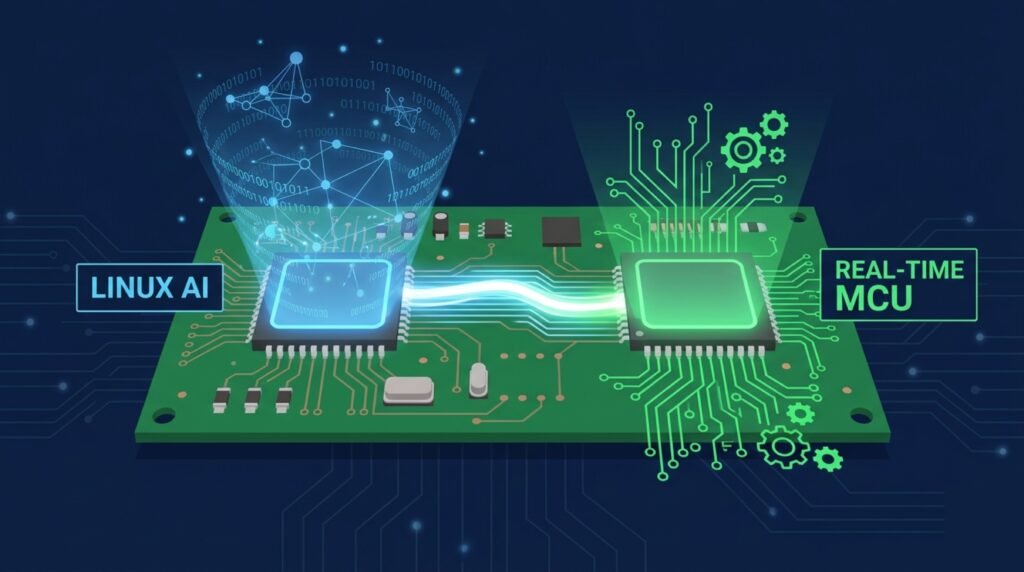
The Arduino UNO Q is officially a Single Board Computer (SBC) — not just a microcontroller. Launched in October 2025 and updated with a 4GB variant in January 2026, it keeps the familiar rectangular Arduino UNO shape but contains something completely different inside: two processors working together on one board. Think of it this way — the classic Arduino UNO R3 had one brain. The UNO Q has two: a powerful Linux computer and a precise real-time microcontroller, collaborating on a single board the size of a credit card.
The two processors are the Qualcomm Dragonwing QRB2210, which runs full Debian Linux, and the STM32U585 — an Arm Cortex-M33 MCU at 160 MHz — which handles real-time hardware tasks. The 4GB model at $59 is the one most students and researchers should consider.
About the Raspberry Pi 5?
The Raspberry Pi 5 is the fifth generation of the world’s most popular SBC, running a Broadcom BCM2712 quad-core Cortex-A76 processor at 2.4 GHz. It is a pure Linux computer — excellent at running software, hosting servers, playing media, and even running AI models with an optional AI HAT+ add-on. What it cannot do is real-time hardware control. Connecting a motor and expecting microsecond-precise signals is something Linux-based boards simply are not designed for.
One important 2026 development: due to a global LPDDR4 RAM shortage driven by AI infrastructure demand, Raspberry Pi prices have risen significantly. The 4GB Pi 5 that once cost $60 now costs $75 or more, the 8GB model has crossed $110, and the 16GB variant reached $205 before climbing even further. This price pressure makes the UNO Q’s flat $59 pricing for the 4GB model considerably more attractive than it was six months ago.
Full Spec Comparison — Arduino UNO Q vs Raspberry Pi 5 vs Ventuno Q
| Spec | Arduino UNO Q (4GB) | Raspberry Pi 5 (8GB) | Arduino Ventuno Q |
|---|---|---|---|
| Main Processor | Qualcomm QRB2210 + STM32U585 MCU |
Broadcom BCM2712 Quad-core Cortex-A76 |
Dragonwing IQ-8275 + STM32H5 MCU |
| Clock Speed | Up to 2.0 GHz | 2.4 GHz Faster | 2.35 GHz (Gold Prime) |
| RAM | 2 GB / 4 GB LPDDR4 | 1–16 GB LPDDR4X More options | 16 GB LPDDR5 |
| Storage | 16 / 32 GB eMMC | microSD + PCIe M.2 Flexible | 64 GB eMMC + M.2 NVMe |
| Real-time MCU | STM32U585 @ 160 MHz Yes | None (Linux only) No | STM32H5 @ 250 MHz |
| OS Support | Debian Linux + Zephyr | Raspberry Pi OS (Debian) Mature ecosystem | Linux + ROS 2 |
| Built-in AI / NPU | Edge AI via Qualcomm DSP | None built-in (AI HAT+ add-on) | 40 TOPS NPU Best |
| Wireless | Wi-Fi 5 + BT 5.1 | Wi-Fi 5 + BT 5.0 Tie | Wi-Fi 6 + BT 5.3 |
| Video Out | USB-C (via dongle) | 2× Micro HDMI Better | HDMI + MIPI DSI |
| Arduino Shields | Full UNO compatible Yes | No No | Full UNO + RPi HAT |
| GPIO / Pins | UNO headers + Qwiic | 40-pin GPIO header Standard | UNO + RPi 40-pin + Qwiic |
| LED Matrix | 8×13 built-in Yes | None | Built-in |
| Price (2026) | $49 / $59 Best value | $45–$205 (RAM crisis prices) | Under $300 |
| Community Size | Growing (new 2025) | Massive (10+ years) Winner | Very new (2026) |
what is the difference between Arduino UNO Q and Raspberry Pi 5
This is the most important distinction between the two boards, and it is architectural — not a spec on a sheet.
The Raspberry Pi 5 runs Linux, and Linux is not designed for real-time tasks. When your code says “send a signal every 5 milliseconds,” Linux might comply — or it might be busy with another process and respond 8 or 12 milliseconds later. For LED blinking, this does not matter. For motor control, robotics actuators, or sensor timing, it absolutely does.
The UNO Q solves this by assigning each job to the right processor. The Qualcomm chip handles AI inference, Python scripts, Wi-Fi communication, and high-level logic — all under Debian Linux. The STM32 microcontroller runs Arduino sketches with hardware-precise timing under Zephyr OS. The two communicate internally. Your Linux-side Python can send a command to the STM32, which executes it in microseconds without Linux latency getting in the way.
For pure robotics and hardware control projects, this dual-brain architecture is a genuine advantage the Raspberry Pi 5 simply cannot replicate — not without adding a separate Arduino board via USB or serial, which is what makers have been doing for years.
Does Arduino UNO Q replace Raspberry Pi
The Raspberry Pi 5 retains meaningful advantages in several areas that matter to students and researchers:
- Raw CPU speed: At 2.4 GHz quad-core Cortex-A76, the Pi 5 is faster for compute-heavy Linux tasks than the UNO Q’s QRB2210.
- Display output: Two micro HDMI ports on the Pi 5 vs USB-C dongle required on the UNO Q — a real convenience advantage for desktop use.
- Storage flexibility: The Pi 5 supports microSD cards plus PCIe M.2 SSDs. The UNO Q uses built-in eMMC only.
- Community and tutorials: The Raspberry Pi ecosystem has 10+ years of tutorials, libraries, forums, and project documentation. The UNO Q is brand new — you will sometimes be on your own.
- Camera support: Pi 5 has mature camera interfaces with a large ecosystem of compatible cameras and OpenCV support.
Arduino UNO Q
- Real-time hardware control built-in: No extra board, no USB cable, no workarounds — the STM32 handles it natively.
- Arduino shield compatibility: All your existing UNO shields plug in directly. The Pi 5 has no such compatibility.
- Price stability: At $59 for the 4GB version, the UNO Q is unaffected by the LPDDR4 RAM crisis hitting Pi 5 prices.
- App Lab: The unified development environment that lets you write Arduino sketches, Python scripts, and AI models from one interface is genuinely easier to manage than the Pi’s fragmented toolchain.
- LED matrix built-in: Small but useful for visual feedback without adding hardware.
- Qwiic connector: Plug-in sensors with no soldering — great for rapid prototyping in labs.
Head-to-head — which board for which project?
| Choose Arduino UNO Q if you need: | Choose Raspberry Pi 5 if you need: |
| Robotics with real-time motor control | Desktop Linux computer |
| AI + hardware in one board | Media server or NAS |
| Existing Arduino shield reuse | Web scraping / server projects |
| Sensor fusion + edge inference | Dual-monitor display output |
| ROS 2 robot prototyping | Massive library & community support |
| IoT with deterministic timing | Camera AI with mature ecosystem |

The 2026 RAM crisis context
One factor that changed the competitive landscape significantly is the global LPDDR4 memory shortage. Driven by AI infrastructure demand from data centres, DRAM prices spiked roughly 7x in 2025. Raspberry Pi had to pass those costs on — the 8GB Pi 5 that launched at $80 now costs over $110, and the 16GB version went from $120 to over $200. The UNO Q, whose eMMC memory is sourced differently, has maintained its $49–$59 pricing. For students and researchers on a budget, this shifts the value equation noticeably in the UNO Q’s favour.
Conclusion — the answer depends on your project
There is no single winner between the Arduino UNO Q and the Raspberry Pi 5 — there is only the right tool for your specific project. If you are building a robot, a real-time sensor system, or an AI-powered hardware device, the UNO Q’s dual-brain architecture gives you capabilities the Pi 5 cannot match at any price. If you are building a media server, a desktop Linux environment, or a project that benefits from a decade of community tutorials, the Pi 5 is still the right call. The most exciting news for 2026 is that you no longer have to choose between software intelligence and hardware precision — the UNO Q puts both on a single board for $59. That is genuinely new.
Arduino UNO Q vs Raspberry Pi 5 2026, which is better Arduino UNO Q or Raspberry Pi 5, STM32U585 vs Raspberry Pi 5 real-time latency, single board computer comparison 2026, Arduino UNO Q vs Raspberry Pi 5 for robotics, best SBC for edge AI 2026, Raspberry Pi 5 vs Arduino UNO Q real-time control, dual brain SBC comparison Arduino Qualcomm, Arduino UNO Q 4GB review 2026, Raspberry Pi 5 alternatives 2026,