Arduino Physical AI Challenge India 2026 — My Week 1 Build Log as a Robotics & AI Company Founder
This is Week 1 of my build log series documenting my participation in the Arduino Physical AI Challenge India 2026. I’ll post one update every week until the project submission deadline on 31st July 2026. If you’re building for this challenge — or thinking about entering — follow along.
First, Let Me Tell You Who I Am
I am not a college student with eight free hours a day.
I am Mohammed Ismail Ahmed — founder of BURAQROBOTICS AI, a Robotics, drones and AI solutions company based in India. I build real drones for real clients. My days involve flight regulations, payload calculations, motor calibrations, and delivery deadlines. On a normal week, stopping to enter a hardware competition is the last thing on my schedule.
And yet — here I am. Registered. Building. And genuinely excited.
So the first thing worth answering in this Week 1 log is simply this: why?
Why I Said Yes to the Arduino Physical AI Challenge India 2026
When I first came across the Arduino Physical AI Challenge India 2026 — organized by Robu.in in partnership with Arduino and Qualcomm — my first reaction was honest skepticism.
Another competition. Another prize announcement. Another event that gets won by a team from a top engineering college with resources I don’t have.
I almost kept scrolling. But then I read the two words at the heart of this competition: Physical AI. Not chatbot AI. Not recommendation engine AI. Not cloud AI running on a server somewhere overseas. Physical AI — intelligence that lives inside machines that move, sense, and act in the real world. AI that makes decisions on the device, in real time, without asking the internet for permission. That stopped me completely. Because that is exactly what I have been building with drones & Robotics for years.
Every autonomous drone is a physical AI system. Every flight controller making hundreds of micro-decisions per second is edge computing in action. Every camera gimbal stabilizing itself mid-flight against wind and vibration is machine intelligence responding to the physical world in real time.
I haven’t been building near Physical AI. I have been building it. I just never called it that. I registered within the hour.
What Is the Arduino Physical AI Challenge India 2026?
For anyone landing on this post who hasn’t heard of it yet — here is the short version.
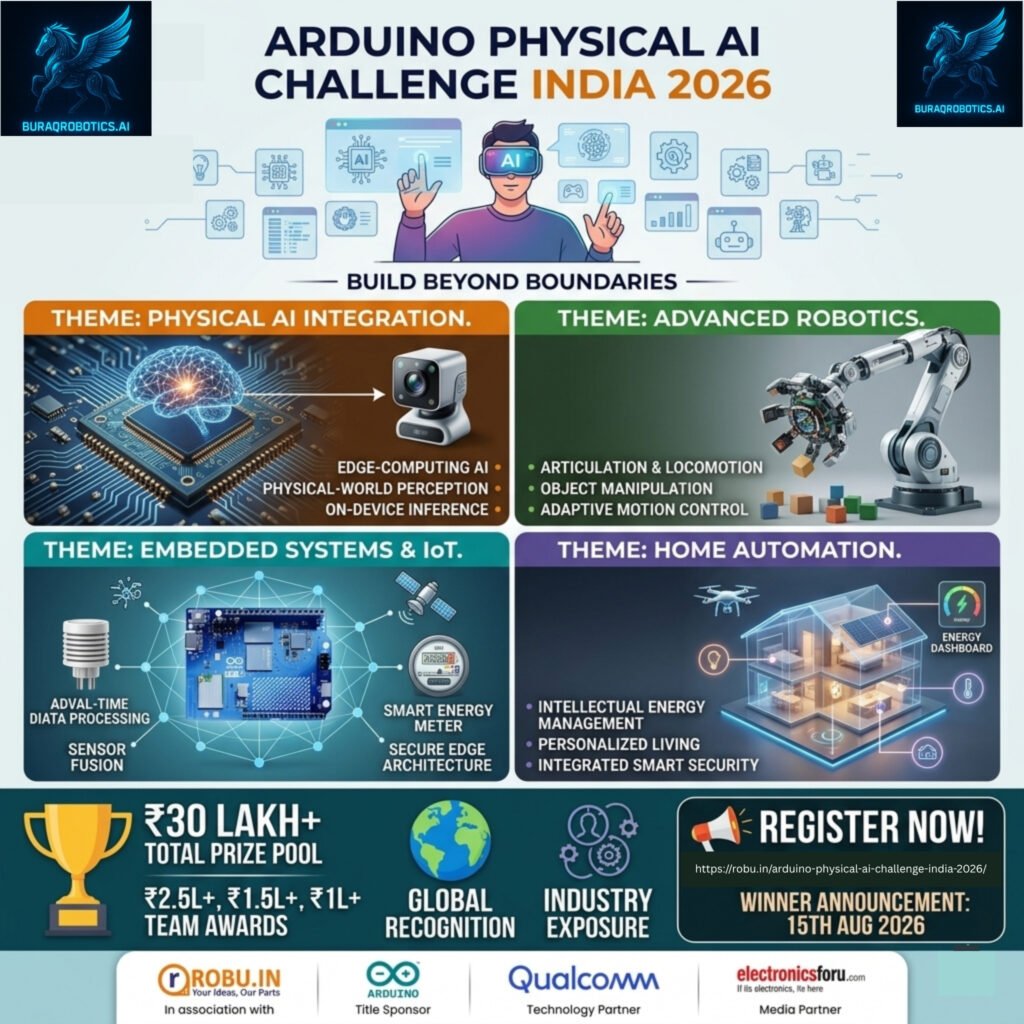
The Arduino Physical AI Challenge India 2026 is India’s largest hardware AI competition this year. Organized by Robu.in — one of India’s most trusted electronics and robotics platforms — in official partnership with Arduino as title sponsor and Qualcomm as technology partner, with ElectronicsForU.com as media partner.
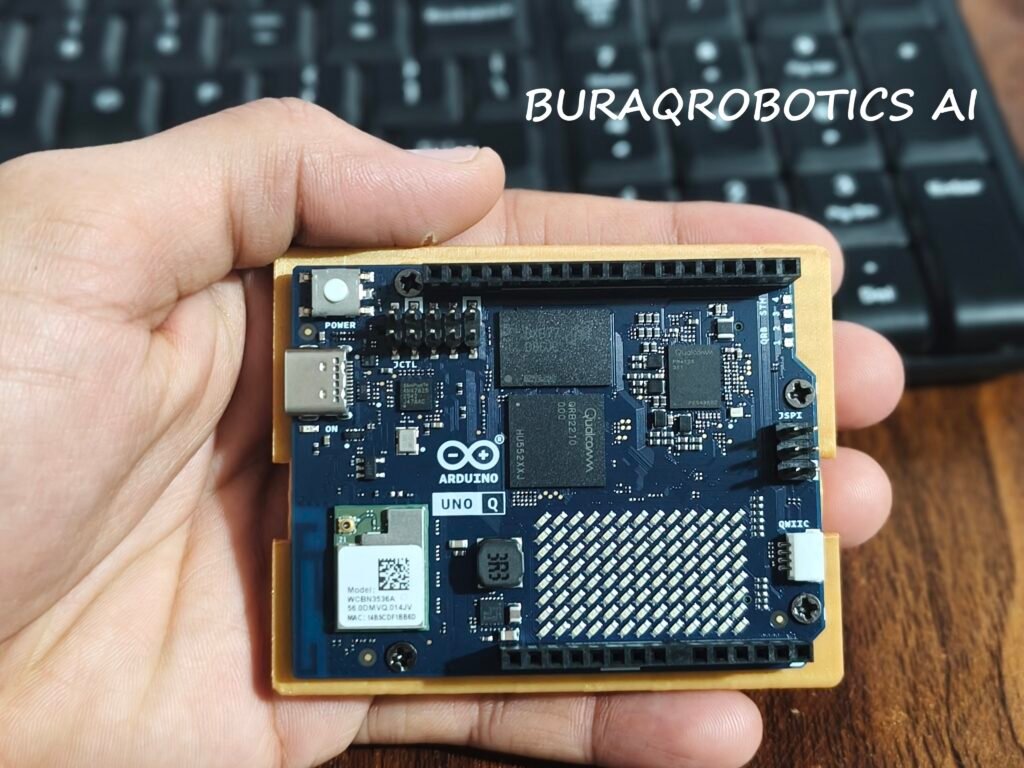
The competition runs on one board: the Arduino UNO Q — a powerful dual-processor platform built specifically for Physical AI applications. It combines a Qualcomm Dragonwing processor running full Linux (for AI inference, computer vision, and Python applications) with an STM32 microcontroller (for real-time sensor and motor control). Two processors. Two roles. One board. One brain thinks, the other reacts — simultaneously.
The total prize pool is ₹30 Lakhs+, including:
- 🥇 Gold Prize — ₹2.5 Lakhs cash + rewards
- 🥈 Silver Prize — ₹1.5 Lakhs cash + rewards
- 🥉 Bronze Prize — ₹1 Lakh cash + rewards
- Snapdragon AI laptops, mentorship, global recognition, and special category prizes
Project submission deadline: 31st July 2026. Winners announced: 15th August 2026 — India’s Independence Day.
Still open for registration: robu.in/arduino-physical-ai-challenge-india-2026
Why Physical AI Matters — Especially in India
Most people still picture AI as something you type questions into on a screen. That version of AI is useful. But it is not the version that will transform India’s farms, factories, hospitals, and roads.
The AI that will change India at ground level is Physical AI — systems embedded inside real machines solving real problems in the real world. A device that detects crop disease before the farmer even notices it. A system that prevents an industrial accident before it happens. A machine that navigates disaster zones where no human can safely go.
India has no shortage of these problems. What it has sometimes lacked is builders willing to bring Physical AI out of research papers and into actual hardware. That is what this competition is asking for. And that is exactly why I think it matters.
My Project — What I Can Tell You
I will be honest — I am keeping the full technical details of my project private until submission. The competition is live, and protecting the specific details of my approach is simply smart.
What I can tell you is this:
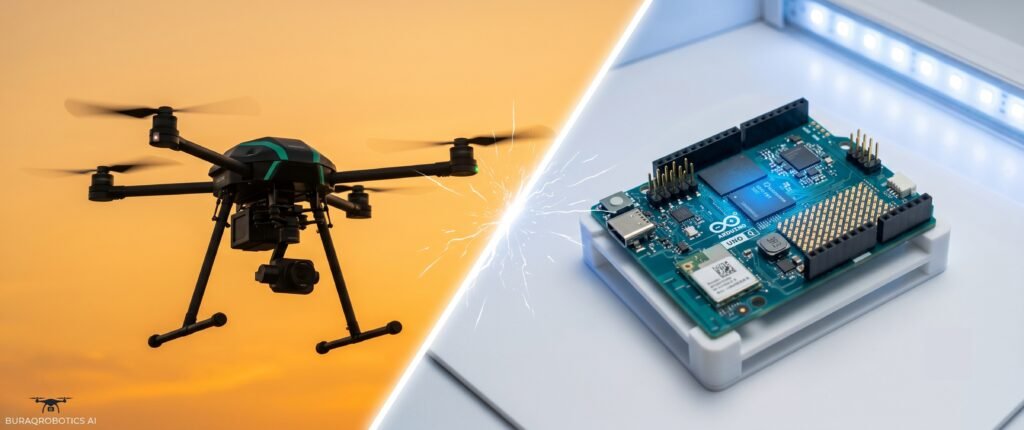
My project sits at the intersection of drone operations and Physical AI. It solves a real, practical problem that anyone working professionally with drones will immediately recognize and understand. It is not a lab demo. It is not built to impress judges on paper. It is built to solve something I have personally encountered doing this work — which means the problem is genuine, the motivation is real, and the documentation will reflect both.
The project uses the Arduino UNO Q’s dual-brain architecture in a way that genuinely requires both processors working together — not just using one side while the other sits idle.
Full technical reveal: 31st July 2026 with the official submission.
Until then — follow the build log. You’ll see the journey without seeing the blueprint.
Week 1 — What I Actually Did
Here is the honest breakdown of what happened this week:
Day 1–2 — Decision and commitment. Locked my project concept on paper. Sketched the problem, the solution architecture, and the user flow. Made a complete component list and cross-checked what I already had in my workshop versus what I needed to order.
Day 3 — Orders placed. Ordered missing components from Robu.in. If you’re building for this competition, order early — delivery in India takes time and the 31st July deadline does not move for anyone.
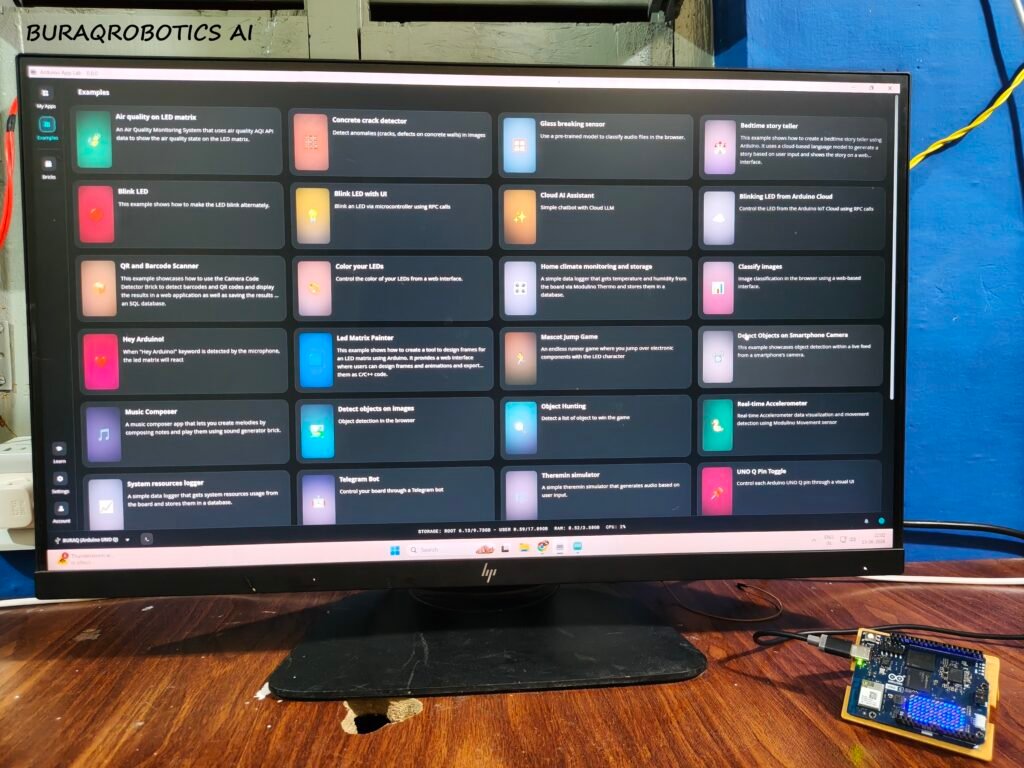
Day 4–5 — Getting familiar with the Arduino UNO Q and App Lab. This board is genuinely different from anything I’ve worked with before. The dual-brain architecture requires a different mental model — you are essentially managing two separate programs that communicate with each other. Arduino App Lab, the official development environment, has a learning curve but makes things significantly more accessible once you understand how it works.
Day 6 — First working test. Got my first meaningful output running — both processors active simultaneously, each doing its job, the two sides talking to each other correctly. The moment it worked was one of those quiet-but-satisfying moments that every builder knows. Nothing impressive to show externally, but internally the foundation is real.
Day 7 — Documentation started. This is important and most participants leave it too late. Documentation carries 30 points in the judging rubric — the single highest-weighted criterion. I started writing my project story, taking progress photos, and logging my decisions from day one. Not after. From day one.
A Note to Every Maker Reading This
If you have been sitting on a project idea — a problem you think about but haven’t built — this competition is worth your time.
The deadline is 31st July 2026. You have enough time to build something real if you start this week. Not a perfect project. A real one. A working one. A documented one.
The competition is open to school students, college students, working professionals, and startups. There are category prizes specifically for school teams, college teams, and women-led AI projects. The prize pool is ₹30 Lakhs+.
I’ll be posting Week 2 next — components in hand, first prototype on the bench, and the first real test of whether my idea works as well in hardware as it does on paper.
Follow the blog at buraqrobotics.com so you don’t miss it.
FAQ — Arduino Physical AI Challenge India 2026
What is the Arduino Physical AI Challenge India 2026? It is India’s largest hardware AI competition of 2026, organized by Robu.in with Arduino and Qualcomm, open to students, makers, and startups across India. Total prize pool is ₹30 Lakhs+.
When is the project submission deadline? 31st July 2026. Winners announced on 15th August 2026 — India’s Independence Day.
What board does the competition use? The Arduino UNO Q — a dual-processor board combining a Qualcomm Dragonwing processor (for AI inference) with an STM32 microcontroller (for real-time hardware control).
Can professionals and startups participate? Yes. The competition is open to everyone in India — students, hobbyists, professionals, and startup founders.
Is registration free? Yes, registration is completely free at robu.in/arduino-physical-ai-challenge-india-2026.
Mohammed is the founder of BuraqRobotics AI — a Robotics, drone and AI solutions company in India. Follow this blog for the complete weekly build log series and connect on LinkedIn, Instagram, and Facebook.
Website: buraqrobotics.com
Arduino Physical AI Challenge India 2026 build log, Arduino Physical AI Challenge 2026 registration, hardware AI competition India 2026, Arduino UNO Q projects India tutorial, how to build AI drone project India, best robotics competition India 2026, Indian maker community Arduino AI challenge, what is the Arduino UNO Q board used for, Arduino Physical AI Challenge India 2026 winners, who can participate in Arduino Physical AI Challenge India, Arduino UNO Q drone project build India,