
Arduino Physical AI Challenge India 2026 — Build Log Week 3: Why I Slowed Down On Purpose
This is Week 3 of my build log series for the Arduino Physical AI Challenge India 2026. If you read Week 1, you know my background — I’m Mohammed, founder of BuraqRobotics AI, an AI, drone, and robotics solutions company in India. This week’s update looks different from what you might expect. Let me explain why.
No Prototype Photos This Week — And That’s the Point
If you’re expecting a working prototype, a blinking LED, or a robot rolling across my desk this week — I don’t have that for you yet.
What I have instead is something less photogenic but, I’d argue, more important: two weeks of deliberate research, re-thinking, and refinement before touching a soldering iron again.
Here’s why I made that choice, and why I think more participants in this competition should consider doing the same.
The Trap of Building Too Fast
After Week 1, I had momentum. My first “hello world” test was working — both processors on the Arduino UNO Q talking to each other, basic sensor data flowing through. The natural instinct at that point is to keep building immediately. Add the next sensor. Write the next function. Keep the visible progress coming.
I almost did exactly that. And I’m glad I didn’t.
Here’s the problem with building fast in the early stage of a Physical AI project: the first version of your idea is rarely the right one. When you rush from concept straight into wiring and code, you lock yourself into early decisions before you’ve fully understood the problem you’re solving. By the time you realize the approach has a flaw, you’ve already built three weeks of work around it.
So I stopped. And I spent this period doing something that doesn’t produce a single Instagram-worthy photo: research.
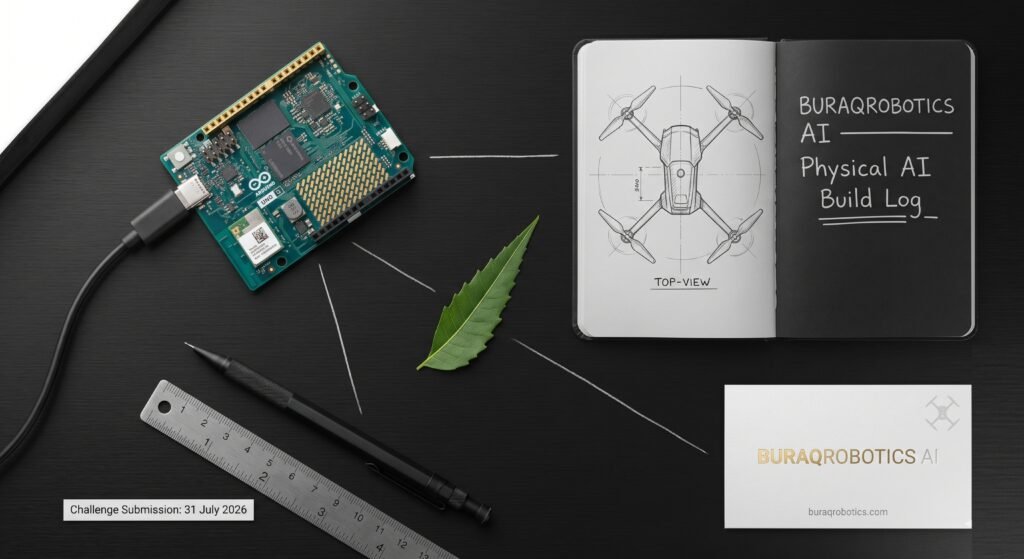
What “Research Phase” Actually Looked Like
For anyone curious what this stage genuinely involves — here’s the honest breakdown, Physical AI specifically:
Studying how the problem actually behaves in the real world.
Before training any model or writing any detection logic, you need real data about how your target problem behaves — its patterns, its edge cases, its false positives. I spent significant time simply observing and documenting the actual conditions my system will need to operate in, rather than assuming I already understood them.
Reviewing how the Arduino UNO Q’s dual-brain architecture handles my specific use case.
The Qualcomm MPU side and the STM32 MCU side each have different strengths. Figuring out exactly which part of my logic belongs on which processor — and how data should flow between them through the Bridge API — took longer than I expected. Getting this division of labor right early saves enormous rework later.
Looking at what’s already been tried — and where it falls short.
I researched existing approaches to similar problems, both in academic projects and commercial products. Understanding where current solutions fail told me exactly where my project needed to add genuine value, rather than rebuilding something that already exists.
Re-scoping what “done” looks like for 31st July.
I was originally scoping a more ambitious version of this project. After this research period, I made the deliberate decision to narrow my scope. A smaller, fully-working, well-documented system will score higher than an ambitious, half-finished one. I’d rather submit something complete than something impressive-sounding but broken.
The Uncomfortable Truth About Build Logs
Here’s something most build logs won’t tell you: not every week looks like progress from the outside.
Some weeks look like a working prototype. Some weeks look like a pile of notes, three browser tabs of documentation, and a notebook full of crossed-out diagrams. Both are real progress. Only one is photogenic.
I’d rather be honest about that here than manufacture a fake milestone just to have something to post.
If you’re building for this competition too and you’re in a similar research-heavy stretch right now — you’re not behind. You’re doing the part of the work that doesn’t show up in screenshots but absolutely shows up in your final documentation score.
What I Can Tell You About Where the Project Stands
I’m still keeping the specific technical details of my project private until submission on 31st July — that hasn’t changed, and for a live competition, it won’t.
What I can share: the research phase clarified the problem significantly. I have a clearer, narrower, more buildable scope than I did after Week 1. The core idea — sitting at the intersection of physical systems and on-device AI — is unchanged. But how I’m approaching the implementation has shifted meaningfully based on what I learned this week.
That’s a good outcome for two weeks of slower, quieter work.
What’s Coming Next
Starting next week, I’m moving back into active building:
- Finalizing the component-to-processor mapping across the UNO Q’s dual-brain architecture
- Setting up the first real data collection pipeline for my use case
- Beginning initial model experimentation
- Getting back to documenting visible, buildable progress
If Week 1 was “why I entered” and Week 3 is “why I slowed down,” Week 4 or 5 should bring the first real prototype photos. I’m looking forward to having something tangible to show.
A Note for Other Participants
If you’re building for the Arduino Physical AI Challenge India 2026 and you feel behind because you don’t have a working prototype yet — pause before you panic.
The submission deadline is 31st July 2026. There is still real time on the clock. A well-researched, clearly-scoped project started in week 3 will beat a rushed, unfocused project started in week 1. Documentation — which carries the highest weight in judging — rewards clarity of thinking, not just speed of building.
Take the time to understand your problem properly. The building goes faster, and better, once you do.
Register here if you haven’t yet: robu.in/arduino-physical-ai-challenge-india-2026
FAQ — Arduino Physical AI Challenge India 2026
Is it okay to spend time on research instead of building early in a hardware AI competition?
Yes — and often advisable. Time spent clearly understanding the problem, the data, and the right division of work between the Arduino UNO Q’s two processors typically saves significantly more time later than it costs upfront.
What is the submission deadline for the Arduino Physical AI Challenge India 2026?
31st July 2026. Winners are announced on 15th August 2026, India’s Independence Day.
Does a slower start hurt your chances in this competition?
Not inherently. Judging weighs documentation, originality, and execution quality far more than how early a prototype first appeared. A clearly scoped, well-documented project started later often outperforms a rushed one started earlier.
Mohammed Ismail Ahmed is the founder of BuraqRobotics AI — an AI, drone, and robotics solutions company in India. Follow this blog for the complete weekly build log series and connect on LinkedIn, Instagram, and Facebook.
Website: buraqrobotics.com
Arduino Physical AI Challenge India 2026 build log week 3, BURAQROBOTICS AI Arduino Physical AI Challenge progress, why research matters before building hardware AI project, how to plan AI hardware project before building, Arduino UNO Q edge AI use case research, Arduino UNO Q dual brain architecture project planning, how much time should you spend planning before building Arduino project, why do hardware projects fail in competitions, drone AI robotics founder Arduino challenge journey,