
Arduino VENTUNO Q Explained: Price in India, Specs, Release Date & Where to Buy (2026)
Arduino just dropped its most powerful board yet, and it’s built for exactly the kind of work we do at BURAQROBOTICS AI — robots and drones that need to see, think, and act in real time, without leaning on the cloud. Meet the Arduino VENTUNO Q.
If you build robotics, drones, or edge AI projects in India, here’s everything currently known about specs, pricing, availability, and how it stacks up against the boards you’re probably already using.
What Is the Arduino VENTUNO Q?
VENTUNO is Italian for “twenty-one” — a nod to Arduino’s 21st anniversary. The board was unveiled at Embedded World in Nuremberg as the second Arduino board released since Qualcomm acquired Arduino in October 2025, following the smaller Arduino UNO Q.
Where the UNO Q proved that a “dual-brain” Linux + microcontroller board could work in a tiny Arduino form factor, the VENTUNO Q is the serious, production-grade version of that idea — built specifically for robotics, computer vision, and industrial actuation rather than hobbyist tinkering.
At its core, VENTUNO Q pairs two processors on one board:
- A Qualcomm Dragonwing IQ-8275 application processor that handles AI inference, vision, and Linux workloads.
- An STM32H5F5 microcontroller that handles real-time, deterministic control — motors, sensors, safety-critical I/O.
The two communicate over an RPC (remote procedure call) bridge, so a single board can perceive its environment, make a decision, and physically act on it — without needing a second device for real-time control like most AI single-board computers require.
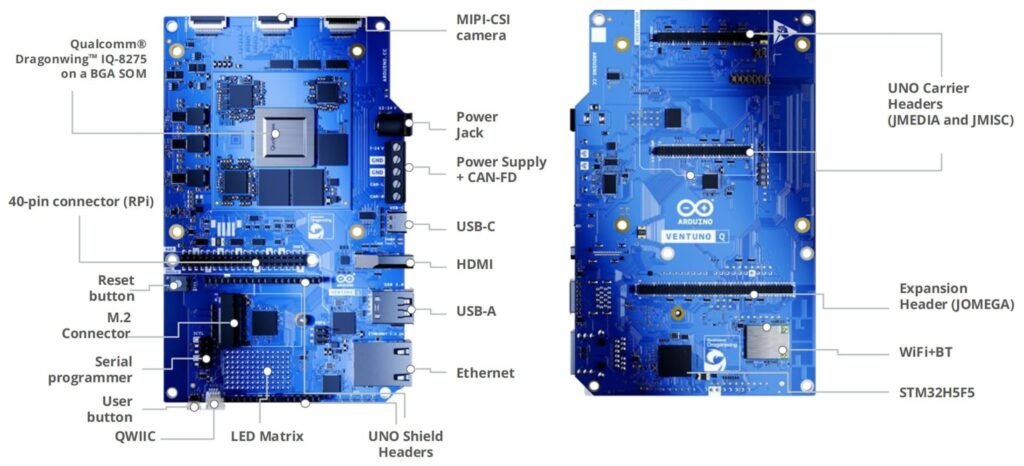
Arduino VENTUNO Q: Full Specifications
| Component | Details |
|---|---|
| AI Processor (MPU) | Qualcomm Dragonwing IQ-8275 — 8-core Kryo CPU @ 2.35GHz, Adreno 623 GPU, Hexagon DSP |
| NPU Performance | Up to 40 TOPS (dense AI compute) |
| Real-time MCU | STM32H5F5 (Arm Cortex-M33), 4MB flash, 1.5MB RAM, runs Arduino Core on Zephyr OS |
| RAM | 16GB LPDDR5 |
| Storage | 64GB industrial-grade eMMC + M.2 connector for NVMe Gen.4 expansion |
| Wireless | Wi-Fi 6, Bluetooth 5.3 |
| Wired Networking | 2.5Gb Ethernet |
| Camera Support | 3x 4-lane MIPI-CSI interfaces (multi-camera, stereo depth, 360° vision) |
| Display Out | MIPI-DSI, HDMI, USB-C DisplayPort Alt Mode |
| Industrial I/O | Native CAN-FD, PWM, high-speed GPIO (Raspberry Pi-style 40-pin header) |
| OS | Ubuntu / Debian Linux (MPU side), Zephyr OS (MCU side) |
| Compatibility | Arduino UNO shields & carriers, Modulino nodes, Qwiic sensors, Raspberry Pi HATs |
| Robotics Support | ROS 2-ready workflows built into the platform |
| Dev Environment | Arduino App Lab (sketches + Python + AI models in one workflow), Edge Impulse Studio integration |
| Availability | Q2 2026 via Arduino Store, DigiKey, Farnell, Macfos, Mouser, RS |
| Price | Not officially announced yet (we’ll update this section the moment Arduino confirms it) |
Inside the Dual-Brain Architecture
The reason this matters more than just “bigger numbers” is how the two chips divide labor.
The Dragonwing IQ-8275 runs full Linux and handles everything compute-heavy: running local LLMs and vision-language models, processing camera feeds, making decisions. The STM32H5F5 sits beside it doing the opposite job — zero-jitter, deterministic timing for motors, actuators, and safety I/O that simply cannot tolerate the kind of latency a general-purpose Linux process introduces.
Most “AI robotics boards” force you to bolt a second microcontroller onto a Raspberry Pi or Jetson to get that real-time reliability. VENTUNO Q ships with both halves already talking to each other out of the box — which is precisely the architecture you want for warehouse robots, drones, and anything that has to move based on what it just perceived, in milliseconds, not seconds.
Arduino VENTUNO Q vs UNO Q vs Raspberry Pi 5 vs Jetson Orin Nano Super
| Arduino VENTUNO Q | Arduino UNO Q (4GB) | Raspberry Pi 5 | Jetson Orin Nano Super | |
|---|---|---|---|---|
| AI Performance | Up to 40 TOPS (dedicated NPU) | No dedicated NPU | No dedicated NPU (AI HAT optional) | Up to 67 TOPS |
| CPU | 8-core Kryo @ 2.35GHz | Quad-core Cortex-A53 @ 2.0GHz | Quad-core Cortex-A76 @ 2.4GHz | 6-core Cortex-A78AE @ 1.7GHz |
| Dedicated Real-Time MCU | Yes — STM32H5F5 | Yes — STM32U585 | No | No |
| RAM | 16GB LPDDR5 | 4GB LPDDR4 | Up to 8GB LPDDR4X | 8GB LPDDR5 |
| Storage | 64GB eMMC + NVMe Gen.4 | 32GB eMMC | microSD / NVMe (external) | microSD / NVMe (external) |
| Native CAN-FD | Yes | No | No | No |
| ROS 2 Ready | Yes, built-in | Limited | Via community setup | Yes, via Isaac ROS |
| Camera Inputs | 3x MIPI-CSI | 1x MIPI-CSI | 2x MIPI-CSI | 2x MIPI-CSI |
| Price (official) | TBA | $59 | ~$60–80 | $249 |
Read this table the right way: VENTUNO Q isn’t trying to out-TOPS the Jetson Orin Nano Super — it’s solving a different problem. Jetson gives you raw AI horsepower but no built-in deterministic MCU, so you’d still need a separate microcontroller for precise motor control. VENTUNO Q gives you both perception and action on one board, which is exactly what real robots and drones need.
Real-World Applications
VENTUNO Q is purpose-built for systems that don’t just observe the world — they act on it:
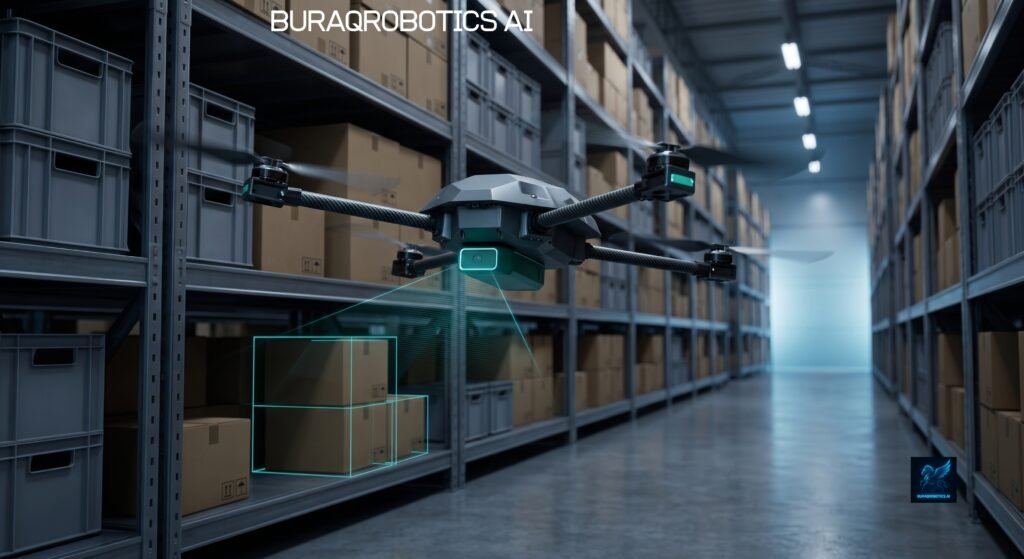
- Warehouse & logistics robotics — multi-camera perception for navigation combined with deterministic motor control for precise movement.
- Autonomous drones — on-device object detection and obstacle avoidance without a cloud round-trip.
- Industrial quality inspection — local vision-language models spotting defects in real time on the production line.
- Offline voice & vision assistants — local LLMs and VLMs (like Qwen) for smart kiosks and healthcare assistants that never touch the internet.
- Security & traffic monitoring — multi-angle camera processing for hazard detection at the edge.
- Education & research — a single accessible platform to teach computer vision, edge AI, and robotics without needing five different boards.
Frequently Asked Questions (FAQs)
When will Arduino VENTUNO Q launch in India? VENTUNO Q is scheduled for Q2 2026 globally through the Arduino Store and resellers including DigiKey, Mouser, Farnell, and RS — all of whom serve the Indian market. An India-specific stock and pricing update typically follows the global launch by a few weeks.
How much will Arduino VENTUNO Q cost? Official pricing has not been announced. Early commentary has speculated a sub-$300 price point given its positioning against the Jetson Orin Nano Super, but this is unconfirmed.
Is the Arduino VENTUNO Q better than Raspberry Pi for robotics? For robotics specifically, yes — VENTUNO Q includes a dedicated real-time microcontroller (STM32H5F5) and a 40 TOPS NPU, neither of which the Raspberry Pi 5 has natively. Raspberry Pi remains a strong general-purpose Linux SBC, but VENTUNO Q is purpose-built for systems that need to perceive and act with precise timing.
Can the Arduino VENTUNO Q run AI models completely offline? Yes. It supports local LLMs and VLMs (such as Qwen), offline speech recognition and text-to-speech, gesture recognition, and object tracking — all running on-device with no cloud dependency.
What’s the difference between Arduino VENTUNO Q and UNO Q? UNO Q is the smaller, lower-cost dual-brain board aimed at makers and education. VENTUNO Q is the larger, significantly more powerful sibling — more RAM, more storage, a stronger NPU, native CAN-FD, and triple camera support — aimed at production robotics, industrial, and vision applications.
Does the Arduino VENTUNO Q support ROS 2? Yes. VENTUNO Q ships with ROS 2-ready workflows built into the platform, so robotics builders can run standard ROS 2 nodes for navigation, perception, and control without needing a separate compute unit for real-time motor commands.
What’s the difference between the AI processor and the microcontroller on the VENTUNO Q? The Dragonwing IQ-8275 runs Linux and handles AI inference, vision processing, and general compute — the “thinking” side. The STM32H5F5 runs Zephyr OS and handles real-time, deterministic tasks like motor control and sensor timing, where even a few milliseconds of delay matters — the “reflex” side. The two communicate over an RPC bridge.
I’m building a warehouse robot — should I use a Jetson Orin Nano or wait for the Arduino VENTUNO Q? If raw AI throughput is the priority, Jetson Orin Nano Super’s 67 TOPS is shipping today and hard to beat. But if the robot needs AI perception and deterministic real-time motor control on one board, VENTUNO Q’s built-in STM32H5 MCU removes the need for a second microcontroller — worth the wait if your timeline allows, since pricing is still unconfirmed.
Is the Arduino VENTUNO Q good for drone object detection? Its 40 TOPS NPU and support for up to three simultaneous MIPI-CSI camera feeds make it well-suited for onboard object detection and obstacle avoidance, processing video locally instead of sending frames to the cloud — exactly the latency profile drones need for real-time avoidance.
What can I build with the Arduino VENTUNO Q? Common use cases include autonomous robots and drones, warehouse and logistics automation, offline voice and vision assistants, industrial quality inspection with vision-language models, and security or traffic monitoring — anywhere a device needs to perceive its environment and act on it in real time.
Does the VENTUNO Q work with Raspberry Pi HATs and Arduino shields? Yes. VENTUNO Q is compatible with Arduino UNO shields and carriers, Modulino nodes, Qwiic sensors, and Raspberry Pi-style HATs via its 40-pin GPIO header, so builders can reuse existing accessories instead of starting their hardware ecosystem from scratch.
How many TOPS does the Arduino VENTUNO Q have, and is that enough for computer vision? VENTUNO Q delivers up to 40 TOPS of NPU performance — enough to run real-time object detection, pose estimation, and small-to-mid-sized vision-language models on-device. That’s below the Jetson Orin Nano Super’s 67 TOPS, but VENTUNO Q compensates with a dedicated real-time MCU that Jetson lacks.
What’s a good alternative to the Jetson Orin Nano for edge AI robotics in India? Arduino VENTUNO Q is shaping up as a strong alternative for builders who need real-time actuation alongside AI inference on one board, while the Raspberry Pi 5 remains the budget option for projects that don’t need heavy on-device AI. The right pick depends on whether your bottleneck is raw AI throughput or perception-plus-control on a single board.

Final Thoughts
The Arduino VENTUNO Q is the clearest signal yet of where edge AI hardware is headed: perception and real-time action on a single board, no cloud required. For anyone building robotics or drones in India, this is a board worth watching closely over the next few months as pricing and availability firm up.
We’ll be tracking the VENTUNO Q closely as it gets closer to launch — including testing it against our own warehouse robotics work once it’s available. Subscribe or check back for updates, and explore how Buraq Robotics AI is already building toward this exact future with on-device edge AI for drones and robotics.
Arduino VENTUNO Q specifications, Arduino VENTUNO Q release date, arduino ventuno q india availability, Arduino VENTUNO Q vs Raspberry pi, Arduino VENTUNO Q price in India, Arduino VENTUNO Q vs Arduino UNO Q difference, Arduino VENTUNU Q robotics applications.